The Good, the Bad, and the Believable

From the time I learned I could string sentences together and create a story, I wanted to write.  I started with fairy tales with princesses and evil witches, and then moved on to barely more realistic stories peopled with righteous children and evil adults.  The characters were cardboard stereotypes – mean teachers, unhappy orphans, and on and on.  People were either good or bad – there was no in-between.  It’s the way the world seemed to me as a child.  Everything was right or wrong, good or bad, fair or unfair.

Of course as we grow up we realize that the world is full of ambiguity, that most people straddle the fence between good and bad at some times in their lives.  Things are complicated.  I want the books I read to be complicated. I want the characters to be fully realized, complicated beings.  I want to feel empathy for even the most unlikable character.

As I’ve said many times, I don’t care a thing about liking the characters in a story or book.  Some of the greatest characters in literature are basically unlikable people (the first that comes to mind is the protagonist in JM Coetzee’s Disgrace).  But there is always some humanity there, something that makes me want to stick with them long enough to find out what happens.  That humanity is what makes a good character.  Not good in the way I thought back when I wrote about those princesses, but good in a way that makes you say, yeah, I believe in this person.
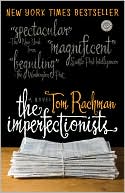
I just finished reading Tom Rachman’s The Imperfectionists, and while I didn’t love the book as much as many critics did, I admire the way he made even the most unlikable characters sympathetic in some way.  In the author’s interview at the end of the book, Rachman addresses this. “Several (characters) are tricky types, the sorts who, had I met them in a newsroom, might have prompted me to run.  But on the page, I had fondness for them.  It’s the writing that did this.  To form these characters, I tried to conceive of their motives, resentments, disappointments … Writing (and reading) is a sort of exercise in empathy… (it) stirs compassion that, in real life, is so often obscured by our own motives.”

I love that.  “Stirs compassion that in real life is so often obscured by our own motives.”  I believe that the best fiction does this, for the reader and the writer.  That’s what I want in my own stories.

Lucky Writing Charms

Writers can be a superstitious lot.  And while I’ve never carried a four leaf clover or worried about walking under a ladder, I do have to admit that I am guilty of a bit of superstition when it comes to my writing.

I have writing charms.  It’s not that I believe they make me write better, or that they ward off writer’s block.  They just make me feel, well, more like Christy the Writer with a capital W.  No reason, really, except that they are important to me, and remind me of the people who believe in me and of the times when I felt most like a writer.

The first time I ever told anyone I was a writer was on my way to an artist’s retreat in Ireland.  My writing had always been a closet occupation – most of my friends didn’t even know I wrote.  I didn’t call myself a writer because I still didn’t believe that I was one.  But something happened when I was on a bus riding through Cork.  The bus driver, a lovely man I could barely understand, asked me what I was doing in southwest Ireland.  When he heard I was headed for Anam Cara, he asked, “So you’re a writer, then?”  And I said, “Yes, I am.”  And realized I actually believed it.  Because though I hadn’t been published yet, publication was not really what it meant to me to be a writer.  What I understood in that moment was that a writer is someone who writes, who needs to write, who spends precious vacation time at a desk struggling over sentences instead of lying on a beach working on a tan.

It was there in Ireland during my long walks along the strand to clear my head that I collected my lucky stones.  And I’ve carried them with me ever since.  Through all my moves, and residencies, and house sitting gigs, they’ve always been nearby to remind me what being a writer really means to me.

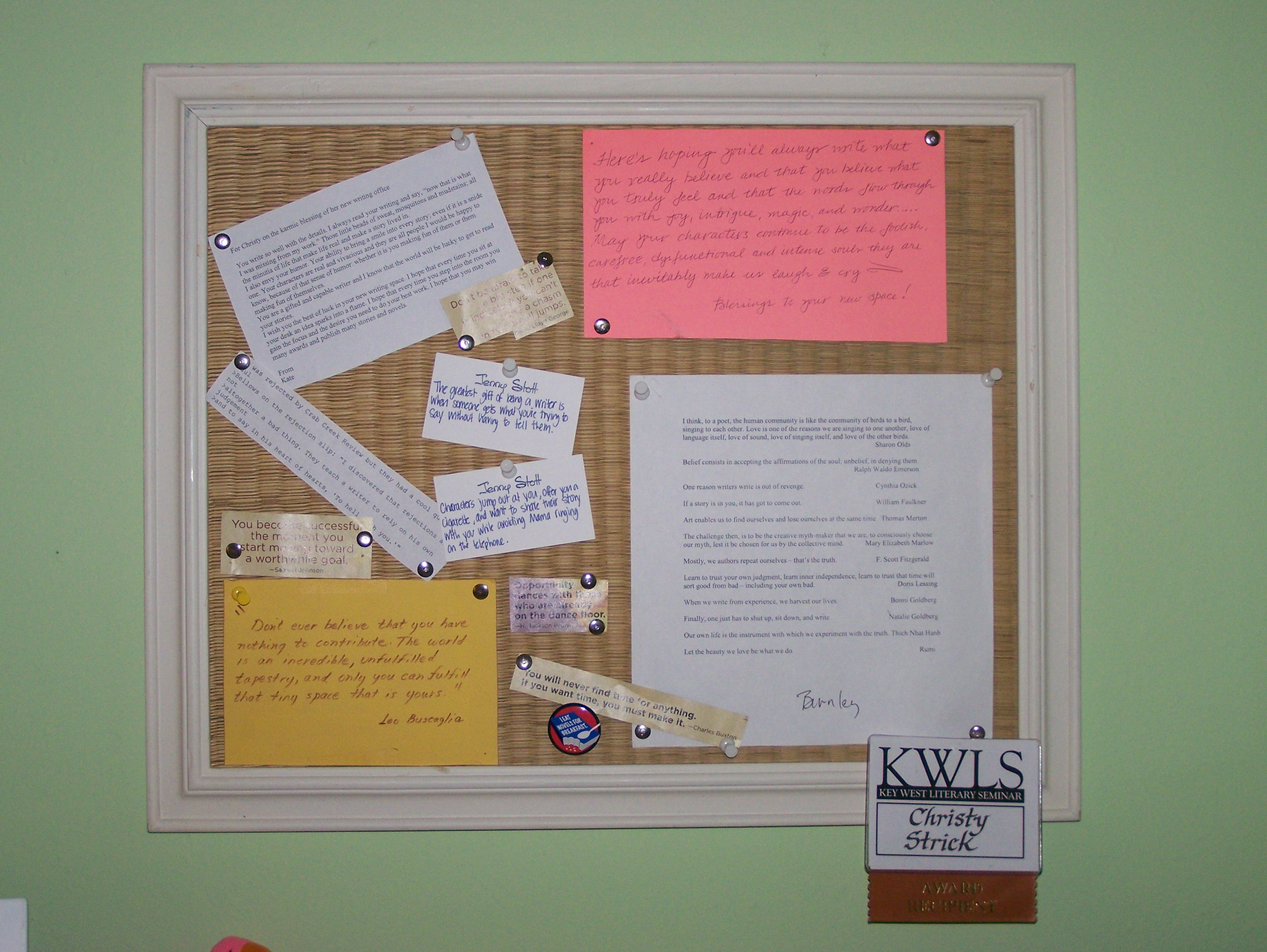
Though I haven’t been able to hang my board everywhere I’ve been, it’s always with me, sometimes leaning against a wall, sometimes lying on the floor nearby.  Long ago, when I christened my first dedicated writing space, my writing group came over and helped me welcome the muse into my new office.  They each wrote wishes for the space, and I still have those good wishes tacked up.  I’ve added a few quotes I like, and stuck a few other things up that mean something only to me.  But mostly the board reminds me of the wonderful women in my group who believed in me and believe in me still.

There are other things I always keep around the writing me:  pictures of my daughters, my first acceptance letter, a pink flamingo.  Can I write without them?  Absolutely. And I have.  But I’d really rather not.

To blog or not to blog, that is the question

A friend of mine asked me not too long ago whether or not she needs a blog.  She’s a wonderful writer with a fabulous book she wants to see published, and she read that before she even submits a query to an agent, she should have a website or a blog.  She needs a platform.

I’ve heard the same thing, over and over again. Blog, tweet, get your name out there.  Agents love the client who already has a following.  I don’t feel qualified to tell anyone what an agent wants or doesn’t want (other than a great book that will sell) but I do have to believe that if the book is terrific, and you find the right agent, and the right publisher comes along, your book will sell, even if you’ve been living under a rock and have never been on the internet.  A lot of ifs, I know, and certainly a huge following can’t hurt, but I hope that in the end, it’s the writing that matters.

The most important thing to remember, I think, is that a blog is just one more outlet for your writing.  If you’re a fiction writer, and blogging (or Facebook or Twitter) takes time away from the real work, the real writing, then don’t do it.  If you can balance blogging with your other writing, and you enjoy it, go ahead.  Just don’t do it because you think you have to.

I have fun with this blog, and I love the connections I’ve made through it, but it’s not my main focus.  My main focus is my fiction.  Sometimes I don’t post every week.  That’s usually a good sign. It means I’m off the internet and writing.