Mental Archeology

This week I had an email conversation with a college boyfriend I haven’t spoken to in years. (OK Greg, I warned you.  Writers use everything.  You are now in my archives.)  That got me thinking about how our past informs our present and our future, how as a writer everything I’ve ever experienced is in my work whether I mean for it to be or not, whether I realize it or not.  Little things, like the crooked smile of someone once in my life, or big things, like the day my father left.  Sweet memories of citizenship awards and hurtful ones of being teased for wearing glasses when I was only in kindergarten.   Encouraging words from my second grade teacher about a story I had written, and harsh ones from the third grade teacher who made me stand in a closet until I almost wet my pants.  It’s all there, somewhere, in the story of the little girl who is afraid of basements, or the boy who is bullied, or the man whose wife leaves him.  In the sun glinting off the water like broken glass, in the acorns crunching under tires echoing those in the driveway of my childhood home.

I think writing is a sort of mental archeology.  You dig for artifacts, most often not knowing exactly what you’re looking for, but gently dusting the dirt from memories, bringing them into the open for others to see.  Usually you have no idea yourself what you’ve found, only that it looks interesting and might be something special.  A smell, a sound, a song.  I try not to think too hard about the context of the memories, only the feelings they invoke.  To me the memories serve not to tell my story, but to tell a universal story, a story that others can connect with.

Because who really cares about my dad leaving, or my citizenship award, or that I listened to James Taylor and Jimmy Buffet and David Bowie in college?  But give me a character and a few of those telling details, and I might come up with a story much more interesting than my own.

The worst thing I can hear from a writer when defending something in workshop is “but it really happened.”  If I want to read a memoir, I’ll read a memoir.  And it better damned well be interesting.  But if I want to read fiction, I want a story, not an autobiography.  While I believe that we use everything in our past as material, it should be used as atmosphere, not the story itself.

So dig deeply, but carefully, and treasure what you unearth as unique material that only you have access to.  Just don’t bore me with the history of the artifact. Give me a story.
Belated Kudos

I’ve been meaning to write this for a month now, but it’s been a busy fall, with weddings and my computer crashing and a bit of writing thrown in.  So here is my belated congrats to my friends on their recent accomplishments in the literary world.

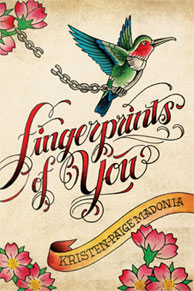
Kristen-Paige Madonia’s young adult novel, Fingerprints of You, was released in August by Simon & Shuster to great reviews.  It’s a beautifully written coming of age story not just for young adults – I loved it – so pick up a copy.  I heard her read from it this week, and will be doing an interview with her here soon.

Sharon Harrigan, a friend and fellow member of WriterHouse, won the Joyce Horton Fiction Award from the Key West Literary Seminar, and will be reading from her work at the Seminar in January.  I’ve asked her to do a guest post on her experience after the seminar, so look for that in late January.

Robert Young, the fearless founder of my current critique group, has a very funny essay about forming a writing group with craigslist ads in the latest edition of The Write Room Literary Magazine.  Robert’s novel in progress is smart and edgy, and I can’t wait to see it in stores one day.

Rachel Unkefer, a long-time friend from my Charlottesville writing group, has another publication credit to add to her CV.  Though she’d never written poetry before recently taking a class at WriterHouse, it is indeed a poem that will appear in Atticus Review.  Not sure yet which issue, but keep a look-out for it.

Cheers to these great writers. And if you have anything coming out soon, shoot me an email and I’ll be happy to let the world know about your good news.

Why We Write

Most people, when I tell them I write, assume I’m in it for the money.  To make millions, like J.K. Rowling or John Grisham.  But the truth is, if I want to make millions, I have a better shot buying a lottery ticket.  The statistics for getting a novel published, much less making any money at it, are daunting.  You spend years writing a novel.  Then, if you are lucky enough to have written something worth publishing, and if you are lucky enough to find an agent to represent you, your odds still suck.  Major publishers get about 5000 agented fiction manuscripts each year, and will publish on average only 5 of them.  That’s a one in 1000 chance of being accepted.  Even if you do find an agent who sells your book to a publisher, the advance for a new writer usually falls somewhere around the $5000 mark.  When you consider that most books take well over two years to write, you’re not exactly making a whole lot of money for the effort.

When I tell people I’m not in it for the fame or the money, they ask why, then, I bother.  My glib answer is that I’m a pathological liar, and that besides being a politician, writing is the only socially acceptable career path I know for a liar.  In truth, I do it because I’m fascinated by people and what makes them do the things they do.  I write to explore human nature, to understand others and myself.

I know many writers, and not one of them has ever said to me that they do it for the money.  In fact, most have other jobs to support their writing habits.  So, because I am interested in why people do the things they do, I asked some of my writer friends to share why they write.

Paula Whyman:

In brief, the first three reasons that always come to me, in ascending order of importance…

1. I write about what I’m curious about.

2. I write in order to examine things and try to figure them out (in a more personal sense than simply what I’m curious about).

3. I write because it’s inseparable from who I am. I often feel like I’m most myself when I’m writing, which is funny because I’m usually writing about characters who have little or nothing to do with me!

Catherine Crittenden:

To make things turn out the way I want them to.

Nica Waters:

1) To communicate. If I write and write well, I can tell someone how I feel without having a weird conversation about it. I will always be glad I wrote a piece for my grandmother, and that she saw it before she died.

2) To figure out something that’s bugging me. This might take the form of writing a fiction piece that weaves bits of life into it, or it might be an essay or a longer non-fiction piece.

Burnley Hayes:

When I write, I write for the thrill of it: the swoosh of words rushing together serendipitously from somewhere outside my conscious control. I’m a little amazed at what I’ve written while in such a state, which is another thrill. The final thrill, if I’m lucky, is that it makes sense.

Lisa Ryan:

I write to capture the things I’ve come to understand and explore the things I don’t.

Elizabeth McCullough:

Right now I mostly write to communicate (like I’m doing now), to connect (via blog, forum, Facebook, etc.), or for hire. I like words, I like making them do what I want them to do. It’s like a puzzle, trying to find exactly the right word, phrase, image, or sentence to convey my meaning in a fresh way. I do it for the challenge and the reward.

Rachel Unkefer:

The First Law of Thermodynamics says that matter (or energy) can neither be created nor destroyed. But when I write, it seems as if I am performing the impossible alchemy of creating something from nothing. A story exists where none did before, and there is no satisfactory explanation for how it got there. It’s a real, tangible, concrete creation that I somehow willed into being.

It will need many applications of the delete key before it goes out in public on its own. It might come home several times, dejected and forlorn, to be dusted off and sent back out to try again. It might never be fully launched, taking up residence in the basement like an over-educated twenty-five-year-old. But it is a thing with a shape and I made it. Nobody else has ever made the exact same thing as the one I made.

It takes as long to make as a pair of mittens, or a bench or a painting. But the only material it uses up is time. That is why I write. To violate the First Law of Thermodynamics.

***

No matter the reason, I’m glad these writers, and so many others, write in spite of the horrible odds. Why do you write?