Catch Me if You Can

In the past year I’ve spent time in four states: Virginia, Florida, SC, and Georgia. I have a suitcase that stays packed in case I decide to hop in the car for a road trip.

There are plenty of people who wouldn’t want the nomadic life I’m living right now. I have stuff scattered from Boston to Virginia to SC – my pictures are in Boston and Newport News, my mountains of books at a friend’s house in C’Ville, and my furniture has been in a storage unit for over a year. What I think I might need or can’t live without (books and writing files, mostly) I carry in the trunk of my car since I never know where I’ll be when I need them next. There are some mornings I wake up unsure where I am, at least for a second.

My lifestyle is hard for some people to understand, and it’s damned near impossible for government agencies. The government wants to be able to find me. Wants to be able to put the long finger of bureaucracy on my pulse at any given moment.

I don’t care about being a citizen of one place, don’t want to have to pick. But I have to have a driver’s license in only one state and a permanent address and all those things that supposedly make us adults. So I have checking accounts in both Virginia and SC, addresses that flip-flop back and forth depending on where I think I’ll be the longest, and library cards in Charlottesville, Mount Pleasant, and Key West.  I have grocery store cards for places in cities I’ll probably never go to again.

The reason I’ve been living like this is so I can pick up and go when I want – to residencies, conferences, special events. I like having options.

But now it looks like I’m back in Mount Pleasant for the foreseeable future. I’ve followed my passion, and this is where it’s led me. I still plan to go to residencies, and conferences, and who knows where else, but it’ll be nice to unpack my files for a bit. Big Brother should be happy. Only don’t tell him, I’m not taking my stuff out of storage yet.

What the day job does for you

People who know me in my other life (the event planner life) often ask me why I don’t use wedding stories in my fiction.  It only makes sense – I entertain my friends all the time with tales of ring-bearing dogs, agoraphobic brides, and drunken groomsmen. (no names, of course)

There are stories there, for sure, but I’m not able to tell them yet.  Not on paper, at least.  I don’t have the distance I need to be able to have perspective.  To be able to create my own characters who would do these crazy things instead of just reworked real people.

That doesn’t mean I don’t use my years of event planning in my writing, though.  A wedding is a microcosm of the world we live in, full of drama and joy and silliness and family relationships.  There’s no better place to observe sibling rivalry, feuding parents, and people with control issues. (they’re the ones telling the band what to play)

Weddings are also terrific for eavesdropping on conversations, for honing my ear for dialogue.  I love to listen in.  And because I always carry a clipboard at weddings, I can jot down lines that I really like.  I never walk on the floor of an event without paper to write on.

If you have a day job, it might be hard to look at it as a good thing for your writing.  For most, the dream is to have all day every day to write.  It can be hard to get your writing done when you’re working 9 to 5 – I know that.  But I think there are some positive things about having a day job.

  • For a part of each day you get out of your own head and have actual conversations with people other than imaginary friends.
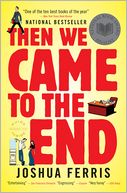
  • There’s so much material in the work place.  If you don’t believe me, read my favorite workplace book, Then We Came to the End.
  • Because of the limited time to write, you might just get more done. When I’m working another job, I realize how precious writing time is, and I protect it.  I fight for it. And waiting for the muse is not an option – you either write in the two hours you have or you don’t.

If you don’t have the luxury of writing fulltime, you can still get plenty of writing done in the hours before or after work.  I’ve done it for years.  I’m a late nighter, so I often write until 2 or 3am.  You might be an early riser.  So get up an hour early and write before work.  If it’s important to you, you’ll find the time and energy to do it.

Because of all the weddings I’ve done, I have notebooks full of funny and true dialogue, and enough stories to fill two novels.  Someday, when I’ve processed it all, maybe I’ll use it in my fiction.

To enter or not to enter…that is the question

Last week I got an email letting me know that the winner of the Compass Rose Flash Fiction Competition had been chosen and it wasn’t me.  I was, however, named as a finalist, and while that doesn’t get my story in print or earn me any money, it does validate my belief that the story is a good one, and just needs to find the right home.

When I first started sending out my work, I unrealistically entered competition after competition.  Prestigious ones. You know, Iowa Review and the big boys.  Competitions that normally have thousands of entries, from thousands of seasoned writers.  I didn’t know any better.  I figured my odds were as good as anyone else’s.

They weren’t.  I had no idea what those competitions were looking for.  Had no idea just how bad my odds were.  So I optimistically sent in my stories with $15 and $20 checks, and then waited until inevitably I got the letter or email saying thanks for entering, we had lots of great entries this year, sorry yours wasn’t one of them (not really, but that’s what it felt like).  Basically I was contributing to the prize funds for other writers, writers who actually did know what they were doing.

These days, I’m much more educated, and more selective, about entering fiction competitions.  There are a few criteria I use to determine whether or not sending in an entry is worth my time and money.  (This assumes, naturally, that the story is competition ready.)

1)      Is the competition on the up-and-up?  Scams are all over the internet, taking advantage of naïve writers who just want to see their work in print. Do your research.  Poets & Writers is a great place for this – they have a whole section on their website for legitimate competitions and their deadlines.

2)       Is this a competition that’s worth winning?  What makes it worth winning?  Adulation, money, publication in a great journal?  A win in the Joe Blow Write Like a Pro Competition does not do much for your CV.

3)      Do you have a chance in hell of winning?  Is this a competition that will attract thousands of entries, including those from already frequently published writers?  Look for competitions that offer the best odds, like those for emerging writers.  Choose respected journals, but maybe not the holy grail of journals, like  Missouri Review, at least not at first.

4)      How much is the entry fee and how much is the prize fund?  Is the pay-off great enough for the risk?  Run the other way if you see an entry fee of $15 or $20 for a $100 first prize.  This is a money making scheme, and it won’t be you who’s making the money.  On the other hand, $2000 and $3000 prizes are hard to win.  Competition is fierce, and the number of entries large, especially if the entry fee is low.  Look at it like a business.  If they’re only charging $5, but the prize fund is $3000, they have to assume they’ll get a lot of entries to cover prizes and make some money for their magazine.  That, my friends, is the primary purpose of competitions.

5)      What are previous winning stories like?  If you write straight, simple narrative, but the past two or three winners of a competition are experimental and edgy, then that’s probably not the competition for you.  Once again, do your homework.

I would recommend you start with small competitions and work your way up.  Enter local contests. One of my first publications was as winner of an annual short story contest run by The HooK, a weekly newspaper in Charlottesville, VA.  I walked away with a nice check and a publication credit, and was a minor celebrity in my circle of friends for a few weeks.

So, make sure the story is as good as it can be, do your research, and choose competitions with the best odds.  And know that even if you don’t win, just entering does some very positive things for your writing.  You’re much more likely to revise and revise again if it costs you money to submit.  You spend time researching journals and past winners, which will give you a better idea of what they’re looking for when you choose to submit to them again. You learn to carefully follow submission guidelines and to take deadlines seriously.  And most importantly, you’re sending your stories out into the world, believing in them.  Which, in the end, is what every serious writer has to do.